
How the College Football Playoff Selection Really Works (2026 Guide)

If you’ve ever sat there on a Sunday afternoon, staring at the rankings and thinking, “Wait… how did they make it in over that team?”, welcome to college football.
You’re not confused. You’re just stepping into one of the most debated systems in all of sports.
The College Football Playoff Selection Process has always sparked arguments, hot takes, and late-night debates. And now, with the 2026 expanded playoff format, things have become even more exciting, but also a little more complex.
So instead of throwing complicated rules at you, let’s break this down like real fans do, simple, honest, and actually useful. By the end of this guide, you won’t just understand how CFP teams are chosen, you’ll start predicting it yourself.
The Big Shift: Why 2026 Feels Different
For years, only four teams had a shot at the national championship. That meant:
- One loss could destroy a season
- Conference championships sometimes weren’t enough
- And deserving teams were often left out
But in 2026, everything changes.
The playoff now includes 12 teams, which means:
- More opportunities
- More competition
- And way more drama
This new structure is the foundation of the updated College Football Playoff Rules 2026, and it completely reshapes how teams qualify.
So, How Do Teams Qualify for CFP Now?
Let’s walk through it step by step, without overcomplicating things.
Conference Champions Still Matter (A Lot)
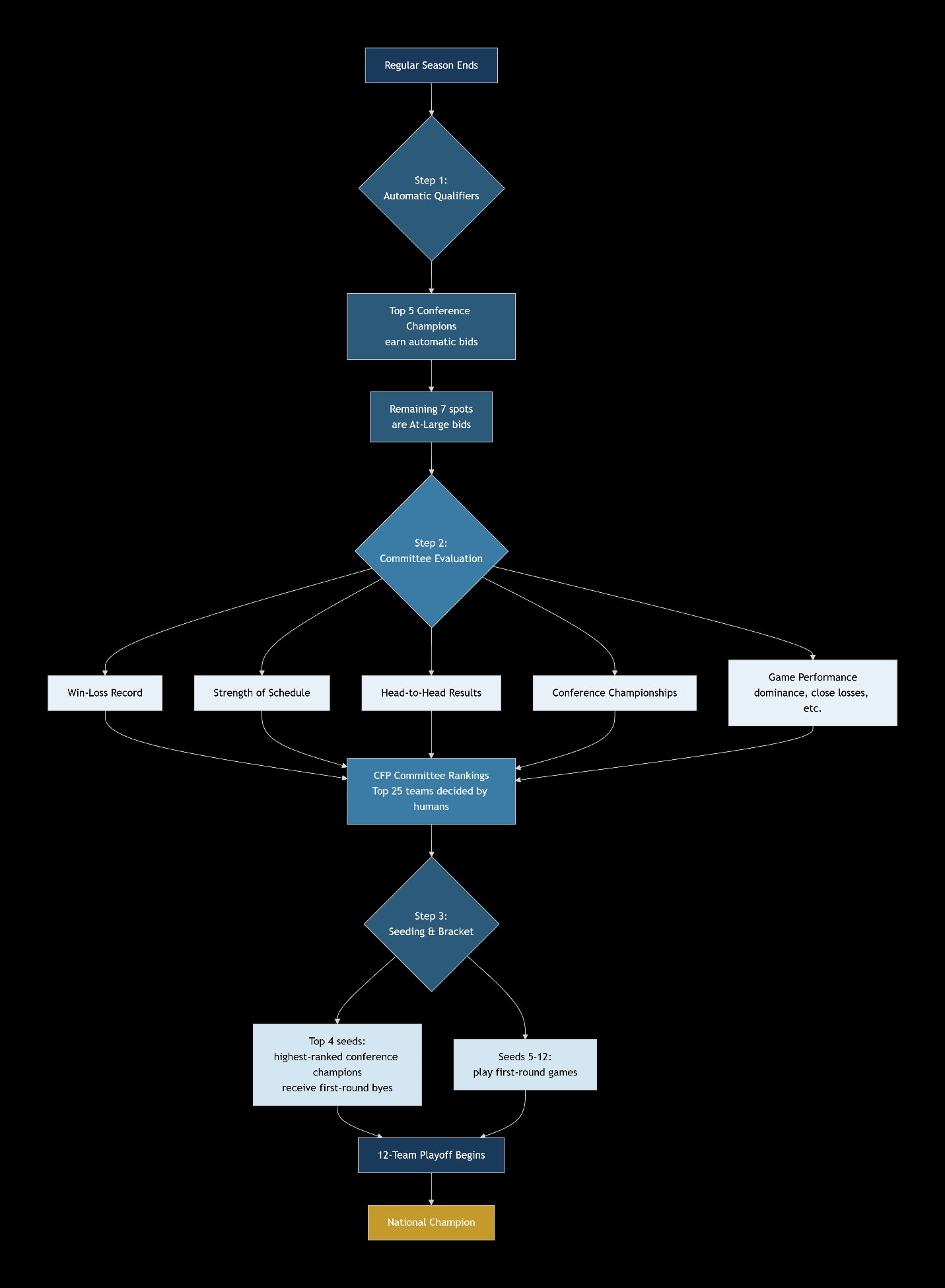
The strongest conference champions automatically earn a place in the playoff. This is a big deal.
Why?
Because it rewards teams that:
- Survive tough conference schedules
- Win high-pressure championship games
- Prove themselves when it matters most
In simple terms, if you dominate your conference, you’re in a strong position.
The At-Large Spots: Where the Real Debate Begins
Once those automatic spots are locked in, the remaining teams are selected based on rankings.
This is where fans start arguing.
These at-large selections depend entirely on the College Football Playoff Committee Rankings, and this is where the real question begins:
How CFP selection works when teams look equally good on paper?
Behind the Scenes: How CFP Teams Are Chosen
Now let’s get into the heart of the matter.
The CFP Selection Criteria Explained isn’t just about picking the teams with the best records. If it were that simple, there wouldn’t be so much debate every year.
Instead, the committee evaluates teams from multiple angles.
It Starts with the Record… But Doesn’t End There
Yes, win-loss record matters. A lot.
But here’s the reality:
An undefeated team isn’t always ranked above a one-loss team.
Why?
Because context matters.
Strength of Schedule Can Change Everything
Not all wins carry the same weight.
Beating top-ranked teams on the road? That’s huge.
Beating lower-tier teams at home? Not so much.
This is why a team with a tougher schedule can rise above others, even with a loss or two.
Head-to-Head Results Add Pressure
If two teams are close in ranking and one beat the other during the season, that result becomes incredibly important.
It’s one of the clearest ways the committee separates similar teams.
Conference Titles Give You an Edge
Winning your conference isn’t just a trophy, it’s a statement.
It shows:
- Consistency
- Performance under pressure
- Ability to win when everything is on the line
And yes, it can push a team ahead in tight playoff decisions.
Performance Matters More Than You Think
The committee doesn’t just ask, “Did you win?”
They also ask, “How did you win?”
- Did you dominate?
- Did you struggle against weaker teams?
- Were your losses close or one-sided?
These details shape the final rankings more than most fans realize.
The Role of the Committee: Humans, Not Just Numbers
One of the biggest reasons the system feels unpredictable is simple:
It’s not controlled by a formula. It’s controlled by people.
The College Football Playoff Committee Rankings are decided by a group of experts who:
- Watch games closely
- Analyze performance
- Compare team’s week after week
This human element is what makes the system both exciting, and controversial.
Because no matter how much data you have, opinions still play a role.
College Football Playoff Rules 2026, Simplified for Fans
Let’s make the structure easy to understand:
- 12 teams make the playoff
- Top conference champions are prioritized
- Remaining spots go to the highest-ranked teams
- Top seeds may receive first-round byes
- Lower-ranked teams compete in early rounds
This new format balances fairness and competition. It gives more teams a chance, but still rewards the best of the best.
Why the Rankings Always Spark Debate
Even when you understand everything, the rankings can still feel… questionable.
Here’s why:
There’s No Perfect System
Every team plays a different schedule. Every game has different conditions.
Comparing teams isn’t always apples to apples.
Late-Season Chaos Changes Everything
One upset in the final weeks can completely reshape the rankings.
A team that looked secure can suddenly fall out. Another can rise at the perfect moment.
Close Decisions Come Down to Small Details
When teams have similar records and performances, the committee looks deeper:
- Quality wins
- Tough losses
- Game control
And that’s where opinions start to differ.
A Real-World Style Scenario
Let’s make this practical.
Imagine two teams:
- Team A: 11–1, but played mostly lower-ranked opponents
- Team B: 10–2, but beat multiple top-ranked teams
Who gets the spot?
In many cases, the committee leans toward Team B.
Why? Because they’ve proven themselves against stronger competition.
This is exactly how teams qualify for CFP becomes more about quality than just numbers.
What Teams Must Do to Make It in 2026
With the new system, teams can’t just rely on a clean record.
They need to:
- Schedule stronger opponents
- Win big games
- Stay consistent all season
- Perform under pressure
Every single game becomes part of their playoff resume.
What This Means for You as a Fan
Once you truly understand the college football playoff selection process, the game changes for you too.
You’ll start to:
- Watch rankings with a sharper eye
- Understand why certain teams move up or down
- Predict possible playoff scenarios
And yes…
You’ll still disagree with the committee sometimes; that’s part of the fun.
Final Thoughts: It’s Not Just Selection, It’s Strategy
At its core, how CFP selection works is a mix of:
- Performance
- Competition
- Strategy
- And human judgment
The 2026 format makes things more inclusive, but it doesn’t make them easier. If anything, it raises the stakes.
Because now, more teams are in the conversation, but only the most complete, battle-tested teams make it all the way.
So, the next time you see the rankings drop and debates start heating up…
You won’t just be watching.
You’ll actually understand how CFP teams are chosen, and why it matters so much.